

Arina Jet has three hours she did not expect. At the terminal window, she checks the time again, as if the afternoon might disappear while she is looking away. Her journey has finished early. Her hotel room will not be ready until later, and there is nothing else she needs to do. Beyond the glass, daylight rests on a quiet stretch of apron. Inside, her black suitcase stands beside her shoes. For once, no announcement belongs to her.
She could sit down and make the hours useful. Her phone offers a familiar list: messages to answer, things to organize, small decisions she has postponed. She opens the list, then closes it. The thought of turning unexpected freedom into another set of tasks makes her tired before she begins. She puts the phone away and reaches into the outside pocket of her case for a small navy sketchbook she has been carrying without opening.
It was meant to be an easy habit. Draw one thing on each journey: a chair, a window, a cup. She had bought the book because its pages were small enough to make the promise seem manageable. Yet most remain empty. The first page contains a careful drawing of a lamp. The second has three unfinished lines, followed by a date from months ago. Arina shuts the cover. Perhaps today she can give the third page something to hold.
A Different Use for the Afternoon
She leaves the terminal with no ambitious destination. A path marked on her map follows the river near the old quarter, within an easy journey of the hotel. She chooses a stretch with covered walkways and public gardens, checks the route, and saves the hotel address before putting her phone back in her bag. Her ivory jacket is still fastened neatly. The gold edge of her hat catches the light as she steps into the afternoon.
At the arcade, the air feels cooler beneath the stone roof. Arina wheels her suitcase slowly past a row of closed windows. The paving is smooth enough for the case, though the wheels click at each join. Outside the arches, the river moves behind a line of trees. She has visited places like this before with a camera ready and a short list of things to see. Today she pauses because a patch of sunlight has landed on an ordinary wooden bench.
She takes a photograph out of habit. On the screen, the scene looks tidy: stone, water, leaves, a bright strip of sky. She could send it with a few words and move on. Instead, she leaves the photograph where it is. She looks at the real bench again. One end sits in shade. A leaf has caught between two slats. The details are unremarkable, which is exactly what makes her want to stay.

The First Uneven Line
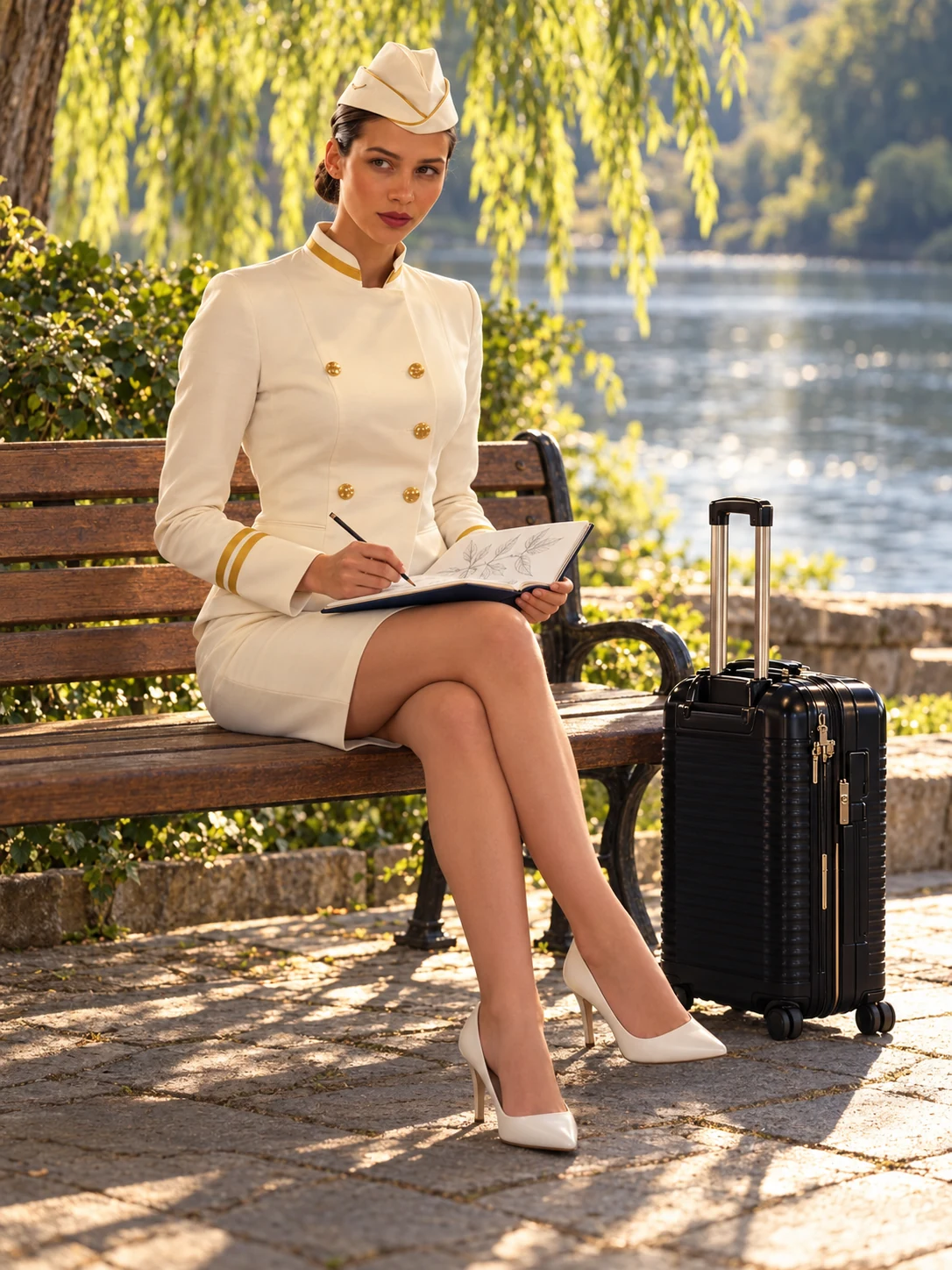
A little farther along, she finds a bench beside the river path. She settles with the suitcase close to her knee and the sketchbook across her lap. There is a pencil clipped inside the cover. Arina takes it out, tests its point against a corner of the page, and begins with the outline of a branch above the water. The first line is too straight. She rubs it lightly with the eraser and tries again.
The second attempt is no better. She had remembered drawing as something that would come back once she had time. Now that time has arrived, her hand seems uncertain what to do with it. She turns the book slightly, checks the branch, and draws a small leaf. It looks more like a spoon. A laugh escapes her before she can decide whether the mistake is disappointing. She adds another leaf beside it.
For several minutes, she works with the concentration she usually reserves for things that must be done correctly. She measures the spaces between leaves, adjusts a stem, and notices that she has barely looked at the river. The page has become another assignment. Arina lowers the pencil and rests her hands on the open book. There is no one here asking for a finished picture. She does not need to prove that the afternoon has been worthwhile.
She starts again lower down the page, leaving the first attempt in place. This time she follows the shapes without measuring them. A thin curve becomes the branch. Three uneven leaves hang from it. She puts a few loose marks beneath them for the water and stops before she can correct every one. It is a small drawing, imperfect and recognizable. She likes it more than the neat lamp on the first page.
Something She Used to Enjoy
When she was younger, she drew whenever there was paper nearby. She did not call it a practice, a goal, or a way to improve herself. It was simply something she enjoyed doing while the rest of the day happened around her. Somewhere along the way, she had begun to require a reason for it. She needed to get better, finish a project, or make something she could show. The enjoyment had survived, but she had made it difficult to reach.
Arina turns to a fresh page and draws the handle of her suitcase. It is right in front of her, with two silver rails and a dark curved grip. She has looked at it countless times without noticing its shape. The sketch takes only a few minutes. A crooked rail remains crooked. She writes the date beneath it, then closes the book for a moment. The case has carried her belongings through another journey. Today it has also become the subject of one.
The light changes while she sits. What was bright on the far bank grows softer, and the shadow of the bench lengthens across the path. She checks the time and finds that she still has enough to walk before heading to the hotel. Her phone shows messages waiting. She answers the one that needs a reply, leaves the others for later, and checks the route back. This is a break inside an ordinary day, not an escape from the rest of her life.
Enough to Keep
She follows the river toward a small stone footbridge. The suitcase rolls quietly on the smoother path, and she carries the navy book in her free hand. From the bridge, the gardens appear in layers: low hedges, pale gravel, taller trees just beginning to turn. Arina stops near the parapet. She considers drawing the whole view, then decides against it. There are more details than she can comfortably fit on a little page, and she does not want to hurry.
Instead, she remembers three things she could draw another time: the curve of the bridge, a narrow garden gate, the shape of a leaf that has fallen onto the stone. That is enough. She does not photograph everything or make a plan to return on a particular date. She stands for a minute with the closed book resting against her jacket. The late light is warm on the gold buttons. Below her, the river carries a few leaves beyond the bend.

By the time she reaches the hotel, the room is ready. Arina sets her suitcase beside the wardrobe and lays the sketchbook on the desk rather than leaving it zipped away. Before changing out of her uniform, she opens it to the two pages she has used. Neither drawing would make a remarkable picture to share. One shows a branch. The other shows a suitcase handle. Both remind her exactly where she was when she made them.
She writes one sentence under the branch: I had time, and I let myself use it. Then she places the pencil across the page. Tomorrow may have a tighter schedule. She knows better than to promise that every day will allow an afternoon by a river. But a small drawing can fit into less time than she had imagined. She does not need to wait for perfect light, a beautiful destination, or a long stretch of freedom before opening the book again.
Later, when she puts her things in order for the morning, the navy sketchbook goes into the same pocket of the black case. This time the pencil is tucked beside it where her fingers will find it easily. The afternoon has not changed her plans or solved anything grand. It has given her two used pages and a habit that feels welcoming again. That is what she keeps from it: something small she wants to continue, with room left for the next uneven line.
An original fictional lifestyle story featuring Arina Jet. The AI-created illustrations use the supplied character reference; the location and events are imagined.