
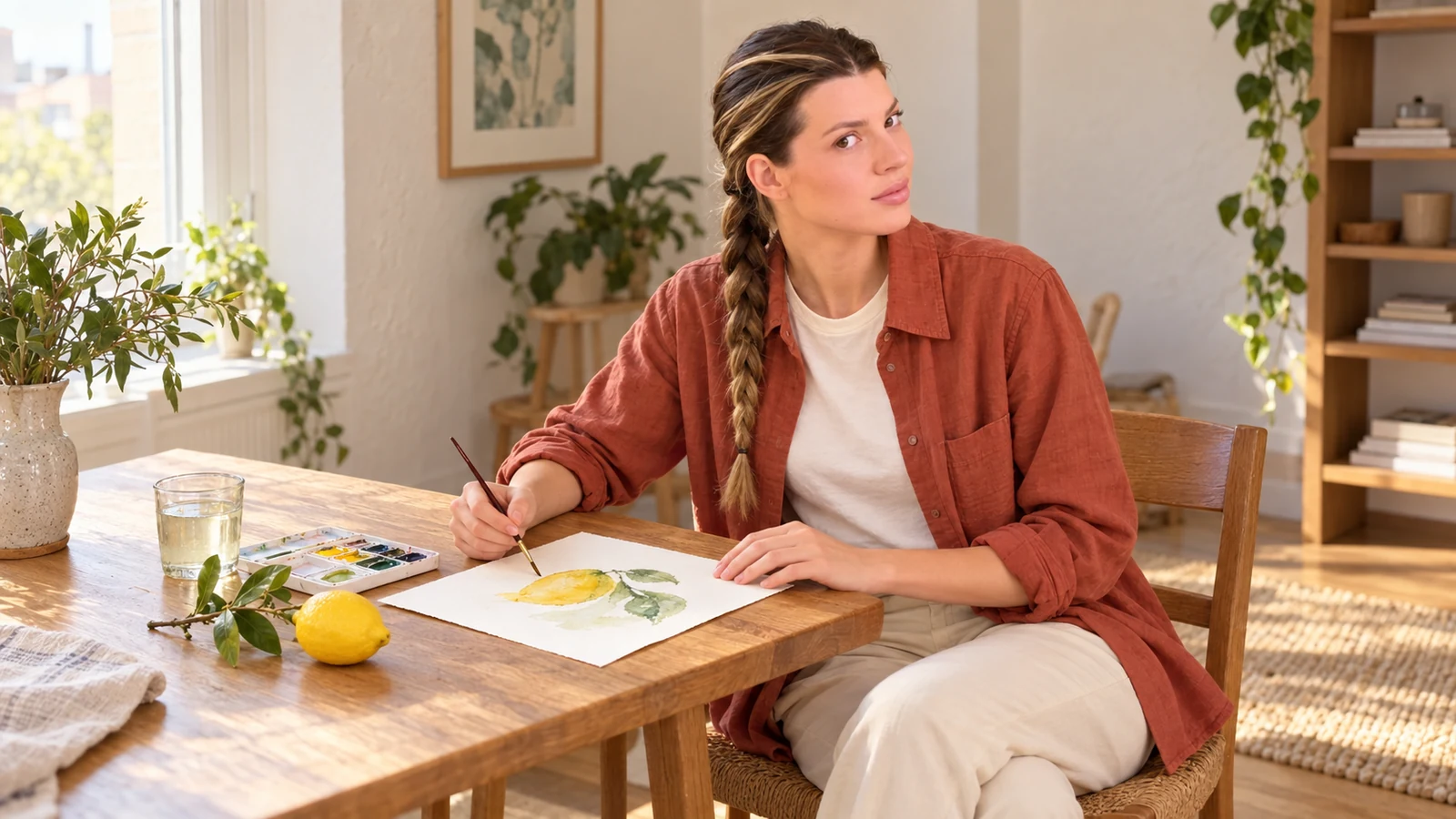
The lemon on Arina Jet's table has a small mark near its stem. She notices it only after sitting down to paint. Until then, it has been an ordinary piece of fruit, something she might slice into water or leave in the kitchen bowl. Beside it lies a short green twig. Together, they are the subject of her first small watercolor in years, and she is already looking at them differently.
A Small Set, a Simple Beginning
Earlier that morning, she had passed an art-supply shop on a familiar street. A box of watercolors in the window reminded her of the paints she enjoyed using as a child. She stopped, looked at the colors and decided to go inside. There was room in her afternoon to try something with them. She could begin with a small sheet of paper and see where it led.
Arina had dressed for an easy day at home and a short walk: a terracotta cotton shirt over an ivory T-shirt, cream trousers and tan flat shoes. She added a light beige jacket before going out. Her hair stayed in its familiar braid, the lighter strands catching the morning sun. The clothes were comfortable enough to move in, and she could roll the shirt sleeves back when she returned to the table.
At the shop, she chose a small watercolor box, a brush and a pad of paper. She held the box for a moment, imagining the colors spread across a white page. There were larger sets on the shelf, but she liked the simplicity of this one. Carrying it home would feel like making a modest promise to herself: she would open it that afternoon.
She browsed the paper, comparing the sizes rather than planning a large finished picture. A small pad fitted easily beside the paint box. She chose one she could use at her kitchen table, then put both into her satchel. The project now had a scale she could picture. It would occupy one corner of the table, leaving room for the objects she wanted to paint.
On the walk home, Arina thought about what she might use as a subject. There was a bowl of lemons in the kitchen and a small leafy twig she had saved from arranging greenery. She knew their shapes well enough to begin. She would put them where the light fell and spend a little time looking before opening the paints. The idea made her walk home feel pleasantly purposeful.

A Place to Make Something
She cleared the table, moving a notebook and yesterday's mail to the shelf nearby. A glass of water, the paint box and a clean sheet of paper went into the space she had made. She set the lemon and twig farther back, where her arm would not knock them as she worked. Then she removed her jacket, rolled up her cotton sleeves and sat down.
The table looked different with the materials laid out. There was an activity waiting there, with room for each part of it. Arina liked seeing the colors beside the ivory of the paper and the pale grain of the wood. The terracotta shirt added warmth to the scene, though she had chosen it for comfort rather than a photograph. She rested her hands on the table and looked at the lemon.
Let the First Mark Stay
At first, she wanted to draw the outline exactly. She moved the brush above the page, hesitated and set it down. Looking again, she noticed the lemon was broader at one end than the other. Its shadow was softer than the dark line she had imagined. She decided to start with the patch of yellow and leave herself room to adjust it as she went.
The first mark spread farther than she expected. Arina watched it settle into the paper, then waited before adding another. She had almost reached for a fresh sheet, but the uneven edge reminded her of the uneven fruit in front of her. She kept working on the same page. A little white remained along one side, where the light caught the lemon's curved surface.
She painted the leaf next. Its shape was simple enough to attempt, although the line of the stem wandered slightly. Arina turned the actual twig to look at it more closely, then placed it back beside the lemon. A few strokes gave the small page something like the arrangement on the table. She could recognize the things she had chosen, even in their simplified form.
As she worked, she became interested in details she had previously passed over: a pale edge on the leaf, the way the fruit leaned on the wood, a patch of reflected light below it. Each detail gave her another reason to look. The brush stayed in her right hand; her left steadied the edge of the paper. For a while, this was all she wanted to be doing.
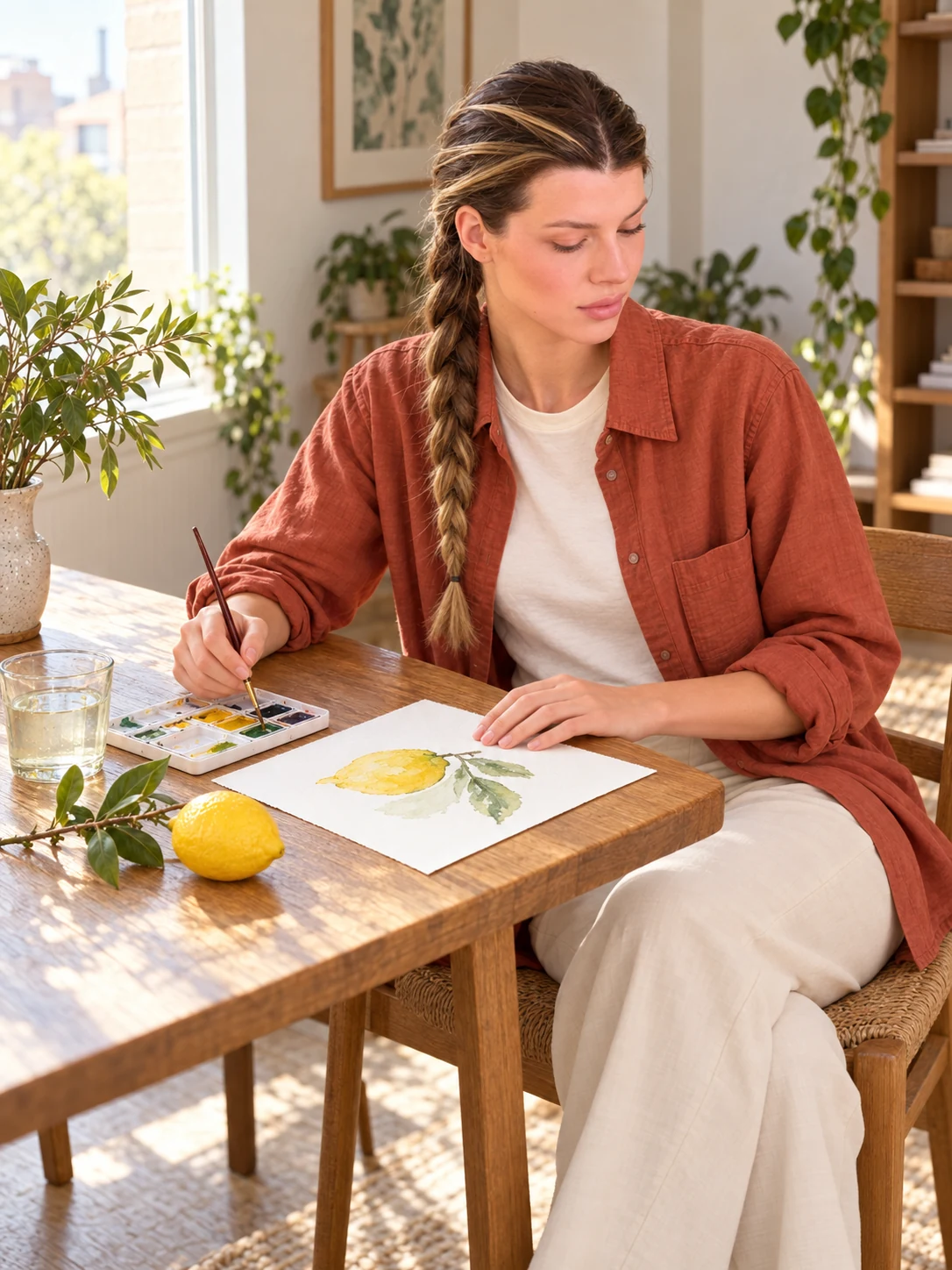
By mid-afternoon, Arina had reached a point where adding more would mostly mean changing marks she already liked. She set the brush down and moved the page to a clear place on the table. From a step away, the lemon looked a little rounder than the original, the leaf a little longer. Still, the colors reminded her of the afternoon she had spent noticing them.
Give It a Place at Home
While the painting dried, she rinsed the brush, emptied the water glass and wiped the small splashes from the table. The materials went together on a tray she could bring out again. Making them easy to put away was part of making the hobby easy to return to. She left the picture where she could see it while preparing something to eat.
Later, she found a small light-wood frame in a cupboard. It had been waiting there since she changed the photograph on her desk. Once the paper was dry, she checked how the watercolor looked inside it. The frame gave the yellow and green a little space of their own. She smiled at how much more finished the modest picture appeared when she held it upright.
Arina carried it to the console beside the living-room window. A plant and a shallow bowl already stood there. She moved the bowl a little to one side and placed the frame where daylight would reach it. The painting was small enough to belong among the objects she used and enjoyed. It brought a warm point of color to a corner she passed several times a day.
She stepped back, changed the angle of the frame and left it there. The room was still familiar, with the same chair, curtains and books. Now there was one new thing she had made herself. Looking at it, she remembered the hesitation before the first brushstroke and the moment she decided to keep the uneven patch of yellow. Those details had become part of the room too.

Keep the Next Afternoon Within Reach
The next picture could be a cup, a branch or the outline of the view from the window. Arina wrote down a few ideas in her notebook, then put the paint box beside it. She liked having another afternoon to look forward to. The materials would be ready, and the first painting had already given her an idea of how she enjoyed working.
There is something useful to borrow from her imagined afternoon: choose a creative activity small enough to begin with what fits your space and time. Give it a clear place to happen, then make the materials easy to find again. Arina used a table, a small paint set and two familiar objects. The pleasure came from using them, looking closely and having something personal to keep afterwards.
That evening, the yellow lemon and green leaf sat inside their light-wood frame on the console. Arina passed the corner on her way to the kitchen and paused. The picture held a small record of the day: the walk to the shop, the rolled sleeves, the water spreading across the page. She adjusted the nearby bowl, pleased with the way the corner looked, and carried on with her evening.
An original illustrated lifestyle story featuring the fictional character Arina Jet. The AI-created images use a supplied visual reference; the home, hobby and events are imagined, not a record of the reference subject's private life.